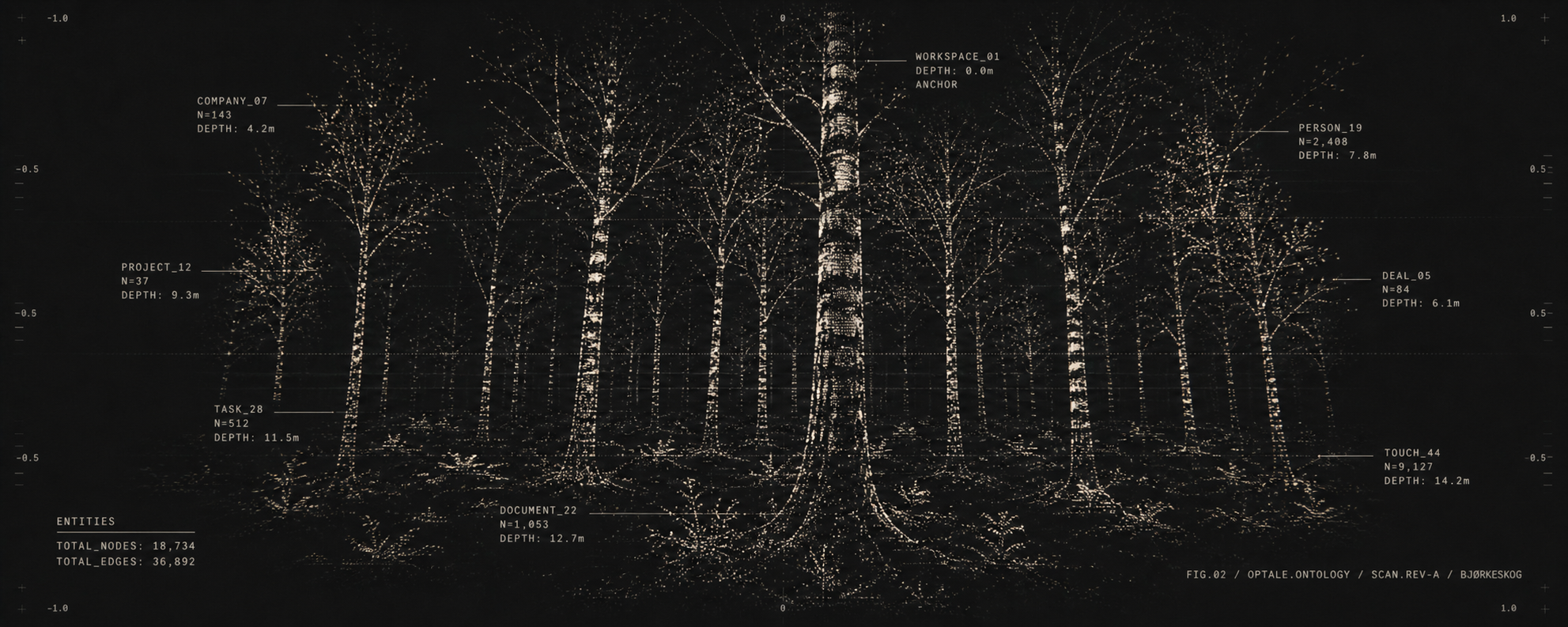
From CRM to digital copy.
A CRM is a funnel built around customers. Your business is a graph: clients, vendors, partners, employees, projects, processes, decisions, dependencies. Ontology maps all of it into one structured, queryable model — the digital copy of how your company actually works. This is the objective reality your AI agents operate within. Without it, they hallucinate. With it, they reason over fact.
One graph, every relationship.
Every person, process, system, and relationship — structured so AI reasons over fact, not guesswork.
Three pillars.
Every entity has a home
Companies, people, deals, processes, dependencies. Typed records with stable identifiers. Agents never invent — they reference.
Temporal awareness
Every entity, relationship and fact is stored with time. Agents can answer not just 'what is' but 'what was' and 'what changed'. The graph remembers.
The objective reality
Agents operating within the Ontology are deterministic, not probabilistic. The structured graph constrains their reasoning to what is actually true about your business.
Under the hood.
Entities, relationships, processes, dependencies.
Who is it for?
Your company's reality is a web of relationships, processes, and dependencies — and you need AI that understands the full picture, not just customer records.
You sell one product to one segment and a pipeline is enough. Ontology is for companies whose business graph is the business.
Digital copy.
Every company that wants serious AI needs a digital copy of how it actually works. Ontology is that copy — structured, queryable, temporal. It is the foundation that makes everything else deterministic instead of probabilistic.